
The Menopause Guide.
The conversation most women only get once they're already in a specialist's room, written down, freely available, and updated each year.
“The most useful thing I can give a patient is twenty minutes of unhurried explanation. The next most useful thing is to write it down so they can read it again in their own time.”
This guide is the second of those. It covers the recognised symptoms of perimenopause and menopause, the myths about HRT that keep too many women out of treatment, and what to do if any of it sounds like you. It isn't a substitute for an appointment, but it is a head start on one.
Last reviewed: January 2026. Sources: NICE NG23, British Menopause Society consensus statements (2024), RCOG Scientific Impact Papers.
Could it be your hormones?
Most women start experiencing symptoms of perimenopause in their early 40s, often before periods change at all. These are the clusters that bring women to the clinic most often.
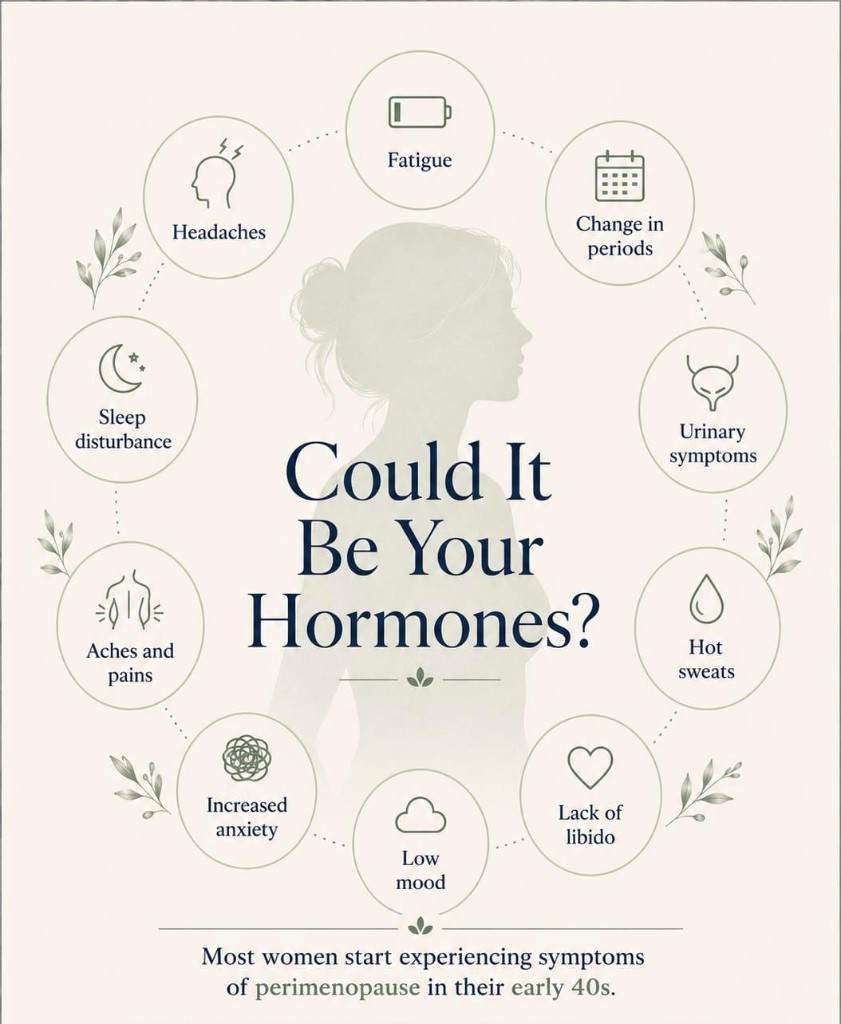
Symptoms by category.
Around forty distinct symptoms are now recognised. Most women experience clusters from three or four of the categories below, often before periods change at all.
The classic symptoms, but not the most common. Around 75% of women experience some vasomotor disruption; about a third describe it as severe and lasting more than five years.
- Sudden flushes lasting one to five minutes, often peaking late afternoon or 4am
- Night sweats, soaked sheets, broken sleep, secondary fatigue
- Palpitations, particularly on waking
- Skin flushing without a temperature change
Most responsive to: oestrogen replacement, with effect typically by 6-12 weeks. CBT and SSRIs are useful alternatives where HRT isn't an option.
One of the most under-recognised symptom clusters, and the one most often misattributed to stress or early dementia.
- Word-finding difficulty, particularly nouns
- Short-term memory lapses (walking into rooms, forgetting names)
- Loss of mental sharpness or “executive function” at work
- Difficulty multi-tasking or holding several threads at once
The good news: these are reversible. Patients often report cognitive return within 8-12 weeks of starting appropriate HRT.
Frequently misdiagnosed as primary depression or anxiety. The hallmark of perimenopausal mood change is its cyclical nature, worse in the late luteal phase, easing with the period.
- New-onset anxiety, often physical (chest tightness, racing thoughts)
- Loss of resilience, small things feel disproportionate
- Rage episodes, often followed by guilt
- Tearfulness with no identifiable trigger
Antidepressants have a role, but oestrogen is often the missing piece, and women with a history of PMS or postnatal depression are particularly susceptible.
Sleep disruption is often the symptom that finally pushes a woman through the clinic door. It compounds every other symptom and is itself an independent risk factor for cardiovascular disease.
- Difficulty falling asleep, often paired with night-time anxiety
- Waking at 3-4am and not being able to return to sleep
- Night sweats fragmenting sleep architecture
- New-onset restless legs
Progesterone (the “P” of HRT) is taken at night for a reason. It has mild sedative properties and is often the part of HRT that women notice first.
Oestrogen has receptors in joint capsules and tendons. Its loss produces a recognisable pattern of stiffness that's often blamed on age or exercise.
- Morning stiffness, easing through the day
- Generalised aching, neck, shoulders, lower back
- Frozen shoulder (adhesive capsulitis), disproportionately common in women aged 45-55
- Plantar fasciitis or new heel pain
Bone density also begins to fall rapidly in the first ten years post-menopause. HRT is the most effective preventive treatment for osteoporosis we have.
Often called the “silent symptom” because women are reluctant to raise it. It's also the symptom most likely to worsen with time if untreated, and the most easily treated.
- Vaginal dryness and discomfort during sex
- Recurrent urinary tract infections
- Urinary urgency and frequency
- Vulval itching or burning
Vaginal oestrogen is safe for almost everyone, including most women with a history of breast cancer. It is not absorbed systemically in any meaningful amount and can be used long-term.
The visible signs, frequently the ones that send women to specialists, but rarely the ones that get acknowledged as hormonal.
- Skin thinning and loss of elasticity (collagen loss is 30% in the first five years)
- Adult-onset acne, particularly along the jawline
- Hair thinning at the crown
- Central weight gain, even without dietary change
- Itchy skin or new sensitivities
Topical oestrogen creams have evidence for skin thickness; the more important interventions are systemic HRT, resistance training, and protein-prioritised eating.
HRT, untangled.
The Women's Health Initiative study was published in 2002. Almost a quarter of a century later, the panic it created, much of which has since been retracted, is still keeping women out of treatment. Eight things worth setting straight.
The risk is real but it is small, and it depends entirely on the type of HRT. Combined oestrogen + progestogen HRT carries a small additional risk of breast cancer of around four extra cases per 1,000 women over five years of use. Oestrogen-only HRT (for women without a uterus) carries no increased risk.
For context: drinking two units of alcohol a day carries a similar risk. Being overweight carries a substantially higher one. HRT remains a small, well-quantified risk that should be weighed against quality of life and the cardiovascular, bone, and cognitive benefits.
It doesn't. Your ovaries continue their decline regardless of whether you're on HRT. What HRT does is replace the hormones you're losing while you go through the transition, then provide protection against the long-term consequences of low oestrogen.
Women often stay on HRT into their 70s and beyond, and current guidance supports this where the benefits outweigh risks for the individual. There is no arbitrary stop date.
For most women over 45, no. NICE guidance is explicit: in women over 45 with typical symptoms, the diagnosis is clinical and bloods are not required. They are often misleading. FSH fluctuates wildly in perimenopause and a “normal” result tells you nothing on the day it was taken.
Bloods are useful in women under 45 (to rule out premature ovarian insufficiency) or where the picture is unclear. They are otherwise a distraction from the conversation that actually matters.
It's a meaningful term, but a narrower one than most websites suggest. Body-identical HRT means hormones with the same molecular structure as those your body produces (17β-oestradiol and micronised progesterone). These are regulated, licensed products available on the NHS.
This is different from “bio-identical” HRT, which usually refers to compounded hormones from private pharmacies. Those are unregulated, the doses are not standardised, and they are not recommended by any UK menopause body.
You generally can, though the risk/benefit conversation shifts. Starting HRT within ten years of menopause carries the best cardiovascular profile. Starting later is not contraindicated, but the route (transdermal preferred) and dose need careful tailoring.
For urogenital symptoms, vaginal oestrogen has no age limit and can be started at any time.
It doesn't, and in some studies it modestly redistributes weight away from the abdomen. Menopause itself drives central weight gain through changes in fat distribution, insulin sensitivity, and muscle mass. HRT can blunt some of that, but it's not a weight-loss tool.
The most effective interventions for midlife weight are resistance training, protein-prioritised eating, and addressing sleep, which HRT also helps.
Oral oestrogen carries a small increase in VTE risk. Transdermal oestrogen (patches, gels, sprays) does not, because it bypasses first-pass liver metabolism. This is why transdermal is now first-line for the vast majority of women starting HRT.
Women with a personal or strong family history of clots can almost always still have HRT. They just need transdermal, micronised progesterone, and a proper risk discussion.
By all means try, but go in with realistic expectations. Black cohosh, red clover, evening primrose oil, and most “menopause supplements” have either no evidence or evidence of no effect beyond placebo. CBT has reasonable evidence for hot flushes. Soy isoflavones have modest evidence.
The “natural first” framing assumes HRT is unnatural, but the oestrogen in modern HRT is bio-identical, and untreated menopause is not the body's default state. It's the body without a hormone it used to have.
What to do next.
Track your symptoms
The single most useful thing you can bring to any first appointment. Track for two weeks. The categories above are a good template.
Speak to your NHS GP
Many women get excellent care on the NHS, particularly with women's health champions in the practice. Try that route before private.
Book private if needed
If the NHS route has stalled, or you want a longer consultation and second opinion, that's exactly what this practice is for.
Ready to talk it through with someone who has time?
Forty-five minutes, in person or by video, with a written plan to take away.
Frequently Asked Questions
Perimenopause is the transitional phase before menopause, when oestrogen levels begin to fluctuate and symptoms such as irregular periods, hot flushes, mood changes and brain fog can start, typically in your early to mid-40s. Menopause is reached when your periods have stopped for 12 consecutive months, usually around age 51 for Caucasian women and 46 to 48 for South Asian women. Many women experience their most significant symptoms during perimenopause, before menopause is officially reached.
Perimenopause can be difficult to recognise because symptoms vary widely and are often attributed to stress, busy lifestyles, or other conditions. Common signs include irregular periods, hot flushes, night sweats, low mood, anxiety, fatigue, brain fog, joint aches and changes in libido. If you are over 45 and experiencing these symptoms, perimenopause is likely. A consultation with a menopause-trained GP can help you connect the dots and explore your options.
Not necessarily. If you are over 45 and your symptoms are consistent with perimenopause, a diagnosis can be made on clinical grounds without blood tests. Blood tests can be useful in certain circumstances, such as if you are under 45 or your symptoms are atypical. During your consultation I will advise whether testing is appropriate in your specific situation.
For most women, modern HRT is safe and the benefits outweigh the risks. Much of the concern around HRT stems from a 2002 study that has since been significantly revised. The small increased risk of breast cancer associated with combined HRT is comparable to the risk from drinking two glasses of wine daily. Transdermal HRT (patches, gels, or sprays), which is my preferred approach, does not increase the risk of blood clots. I will discuss your individual risk profile with you in detail during your consultation.
There is no arbitrary time limit. The decision to continue HRT should be reviewed regularly and based on your ongoing symptoms, personal preferences and individual risk profile. Many women safely use HRT for 10 years or longer, and some continue into their 60s and beyond. I will review your treatment at each follow-up appointment and support you in making an informed decision.
Yes, and I would encourage you to ask them. If your NHS surgery has a GP with an interest in women's health or menopause, they may be able to prescribe HRT for you long term, which is the most cost-effective route. I am happy to start your treatment privately and provide a full summary letter so your NHS GP can continue your prescription. If your NHS GP is unwilling or unable to help, I am of course happy to continue your care privately.
Your new patient consultation (45 minutes, £245) includes a full assessment of your symptoms and their impact on your daily life, a review of your medical and family history, blood pressure and weight check, guidance on whether blood tests are indicated, a clear discussion of HRT options including risks and benefits, and a personalised management plan. If HRT is appropriate, I can issue a private prescription at the end of the appointment.
Yes. All consultations, including new patient appointments and follow-ups, are available face to face in Iver, Buckinghamshire, or remotely via video. Remote appointments are available on Wednesday mornings and Fridays, making them accessible to patients across Slough, Uxbridge, Gerrards Cross and beyond.